


- OVERVIEW
Transfusion for the Freight Market
We can see countries are now diversifying their supplies and, in the process, creating new trade routes. Implies market has sort of priced in the Hormuz closure to some extent. Market is very good at adapting and once they price the risk and handicap in, the world moves on Hormuz or no Hormuz.
As supply shortages emerge across crude oil, refined products, petrochemicals, and fertilizers, the market is beginning to adapt through alternative sourcing, rerouting, and strategic partnership.
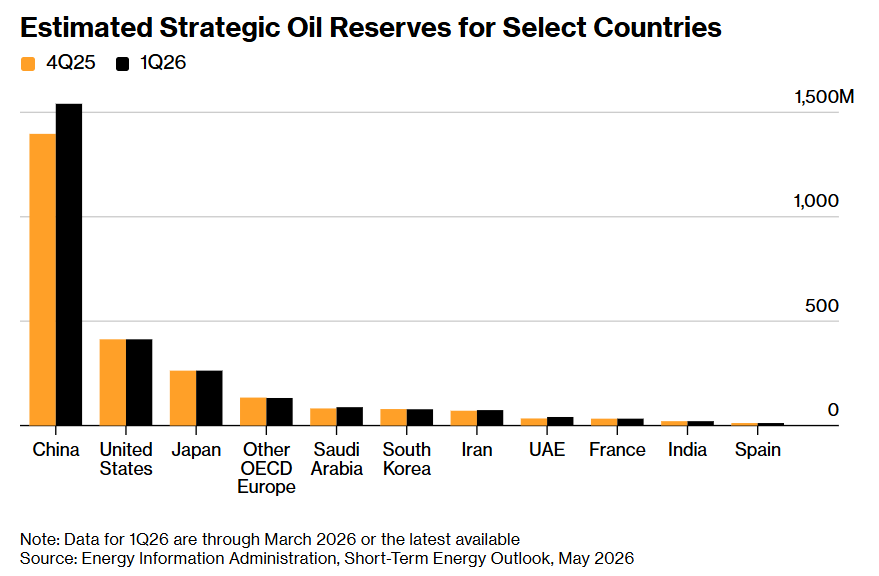
Fresh “transfusions” into the global energy system are gradually emerging from multiple directions. Additional crude and refined barrels are increasingly flowing from the United States, Russia, Fujairah, and selective Gulf producers as import-dependent countries diversify away from excessive reliance on the Arabian Gulf.
European countries are also in negotiation for Tehran regarding safe commercial passage. The war in Iran seems doesn’t have wide bearing over the oil demand in Europe for petroleum products, such as diesel and gasoline.

Singapore and other Asian importers are accelerating energy diversification strategies. More infrastructure is gradually being positioned to accommodate different crude grades and alternative feedstock imports.

Meanwhile, the UAE will double its capacity to export crude oil bypassing the Strait of Hormuz by next year, as it seeks to reduce reliance on the shipping chokepoint. Abu Dhabi National Oil Co. is accelerating the construction of a pipeline that runs to the port of Fujairah on the Gulf of Oman.

Back in the US, the Trump administration will eventually face mounting pressure to stabilize the Strait of Hormuz situation, as global gasoline and refined product prices elevated, and inflation pressure can affect the US economy.

- MR MARKET OUTLOOK FOR THE NEXT 5-7 DAYS
The rate assessments are still pretty strong but that only tells one bit of the story. The numbers are theoretical but volumes are low all-round so it is no use if paper assessments are strong when there are no physical trades to support.
| WORLD SCALE | 12-May-26 | 13-May-26 | 14-May-26 | 7-DAYS AVERAGE | 1-DAY CHANGE | 7-DAYS CHANGE | 7-DAYS-CHANGE |
| SPORE/JPN (30 KT) | 314 | 314 | 301.5 | 319.25 | -12.5 | -26 | -7.94% |
| SPORE/OZ (35 KT) | 350 | 350 | 340 | 352.19 | -10 | -20 | -5.56% |
| SK/OZ (35 KT) | 360 | 360 | 347.5 | 362.81 | -12.5 | -22.5 | -6.08% |
| INDIA/JPN (35 KT) | 315 | 315 | 310 | 318.75 | -5 | -40 | -11.43% |
| $1 = $1K | 12-May-26 | 13-May-26 | 14-May-26 | ||||
| SPORE/HK | 700 | 700 | 685 | 700.00 | -15 | -30 | -4.20% |
| SK/SPORE | 800 | 800 | 770 | 833.13 | -30 | -125 | -13.97% |
| SK/JPN | 555 | 550 | 520 | 581.25 | -30 | -115 | -18.11% |
| SK/H.K. | 680 | 680 | 660 | 713.75 | -20 | -110 | -14.29% |
| SK/USWC | 2170 | 2150 | 2135 | 2,190.63 | -15 | -115 | -5.11% |
| WORLD SCALE | 12-May-26 | 13-May-26 | 14-May-26 | ||||
| AG/JPN (55 KT) | 342.5 | 337.5 | 332.5 | 347.50 | -5 | -32.5 | -8.90% |
| AG/JPN (75 KT) | 322.5 | 317.5 | 312.5 | 327.50 | -5 | -32.5 | -9.42% |
A Japanese refiner bought Mexican crude oil for the first time since 2023 as it navigates supply disruptions triggered by the Iran war and the near-closure of the Strait of Hormuz. Vessels Eagle Kuantan and Eagle Kangar are set to load a combined 1 million barrels of Isthmus crude oil for Cosmo Energy Holdings Co. in coming days, according to a shipping report seen by Bloomberg. The oil, supplied by Petroleos Mexicanos’ trading arm PMI, is loading out of Pemex’s Pajaritos terminal, on the Atlantic coast.
Korea secured roughly 210 million barrels of crude oil for May to July — more than 80 percent of the volume imported over the same period last year, despite massive supply shocks due to the Iran war. Among non–Middle Eastern suppliers, imports from the United States have surged most conspicuously, marking the sharpest increase in Korea’s diversified sourcing mix. ~ Korea Joong Ang Daily

The India–Japan route remains one of the weaker segments in the regional matrix, reflecting softer regional refinery activity and uncertainty surrounding replacement Middle Eastern supply chains. However, the market continues to show structural support from elevated bunker costs, vessel inefficiencies, and ongoing geopolitical rerouting.


The SK–USWC remains comparatively resilient despite a recent correction from elevated levels. The longer-haul nature of Transpacific voyages continues to provide underlying tonne-mile support even as charterers become more cautious on fresh commitments.
Looking ahead, the next 5–7 days remains range bound. Any improvement in replacement export flows from the United States, Russia, or Fujairah could quickly tighten prompt tonnage again.
While short-term freight volatility may continue, the longer-term structural backdrop remains supportive for product tankers:
- longer tonne-miles,
- rerouted cargoes,
- higher inventory security requirements,
- and increasingly inefficient trade patterns.
Shipping historically thrives on inefficiency — and the current market environment is producing exactly that.
- SMALL TANKERS MARKET UPDATE
The regional market remains uneven this week, with Southeast Asia continuing to soften while parts of the Far East show signs of tightening. Intra-SEA activity stayed weak as prompt tonnage built across all vessel sizes, with previously active CPP ships now reopening without follow-on employment amid low plant operating rates and restricted exports linked to ongoing Strait of Hormuz disruptions. Northbound sentiment also remains under pressure, with limited chemical enquiries and growing prompt tonnage forcing owners to reposition toward westbound routes or ballast back to the Far East in search of employment. In contrast, the Intra-FEAST market improved modestly, with steady Korea–China and Japan activity tightening vessel availability for remaining May and early June dates despite ongoing production cuts and turnarounds. Southbound demand remains relatively firm, supported by MTBE, MEAC, methanol, and biofuel movements into the Straits, with limited prompt space pushing charterers toward June laycans and attracting additional Far East owners into the trade. Overall, freight levels across the region continue to hold around last-done levels, although underlying sentiment remains mixed between softer Southeast Asia conditions and tighter Far East southbound availability.

- REPORTED FIXTURES
| VESSEL | SIZE | GRADE | L/C | LOAD | DISCHARGE | FREIGHT | CHTRS |
| VNR | 39 | MTBE | 15-May – 30-May | NORTH CHINA | ARA | $3.75M L/S | CNR |
| GARNET EXPRESS | 35 | CPP | 24-May | KOREA | OZ | WS370 | BP |
| MANOLATES | 35 | CPP | 21-May | TAIWAN | OZ | WS370 | BP |
| MERIDIAN EXPRESS | 35 | CPP | 21-May | SPORE | OZ | WS352.5 | BP |
| GARNET EXPRESS | 35 | CPP | 24-May | KOREA | OZ | WS370 | BP |
| PACIFIC RUBY | 35 | CPP | 26May | DAESAN | USWC-HAWAII | 2.15M | SUNOCO
|
- GLOBAL BUNKER PRICE REPORT

Singapore VLSFO and MGO prices remain historically firm as geopolitical tensions, supply uncertainty, and longer voyage distances sustain fuel demand across major bunkering hubs. The persistent premium in marine gasoil also continues to pressure operating costs for non-scrubber fitted vessels.
- MARKET WATCH
Shipping stocks of major product tankers players such as Norden, Scorpio Tankers, Hafnia, Torm, and Ardmore Shipping continue to strive on new builds, dividend payouts, and operational efficiencies amidst the geopolitical tensions.


According to Tradewinds, Scorpio Tankers-owned vessel has emerged as the second US-flagged ship to have been escorted out of the Middle East Gulf under the now-aborted “Operation Freedom”. The 50,000-dwt CS Anthem (built 2017), formerly the STI Bosphorus, made it through the Strait of Hormuz on on early May according to US operator Crowley-Stena Marine Solutions.


TORM reported a strong first quarter for 2026, with TCE revenue of $286 million and a net profit of $122 million, benefiting from firm freight rates and operational efficiencies. The company increased its full-year guidance to TCE of $1.15 to $1.45 billion, driven by positive market conditions and solid earnings visibility.
TORM continued its fleet renewal strategy by acquiring six MR resale vessels, enhancing fleet flexibility and future earnings capacity. Management highlighted the impact of geopolitical factors, including the closure of the Straits Hormuz, which significantly disrupted global energy flows and elevated tanker rates. The company declared a dividend payout ratio of 58%, impacted by a working capital build-up due to increased freight rates and bunker prices.
(Source: SaxoInvestor)


The Company signed contracts for the construction of two highly-efficient and versatile 40,500 dwt Handysize product/chemical tankers at Wuhu Shipyard, at a price of $44.9 million per vessel, inclusive of approximately $3 million for full IMO2 specification and MarineLine tank coatings. In addition, the Company is commissioning various performance and safety upgrades. The agreement also includes options to acquire two additional vessels on the same terms. Deliveries are scheduled from late 2028.
Effective 1Q 2026, Ardmore is doubling its dividend payout ratio to common shareholders to two-thirds of adjusted earnings.
(Source: SaxoInvestor)

3 Comments
Hope the G7 meeting in June will have a breakthrough solution regarding the global supply shortage and inflation.
Interesting view. The market usually adapts quickly, and business continues once the risk is understood.
Interesting view. The market usually adapts quickly, and business continues once the risk is understood.