


- OVERVIEW
Bracing through Summer
The market expects the Iran war disruption to last into summer, and everyone is preparing for a prolonged, uncertain, and volatile environment, not a quick recovery.
The effective restriction of flows through the Strait of Hormuz continues to distort global product balances, forcing a reshuffling of trade routes and tightening vessel availability across key East of Suez markets.
If Europe is unable to replace more than half of its lost Middle East supply, jet fuel inventories could reach critically low levels by June, according to the International Energy Agency. This raises the risk of physical shortages at key hubs, potentially resulting in flight disruptions and demand destruction.
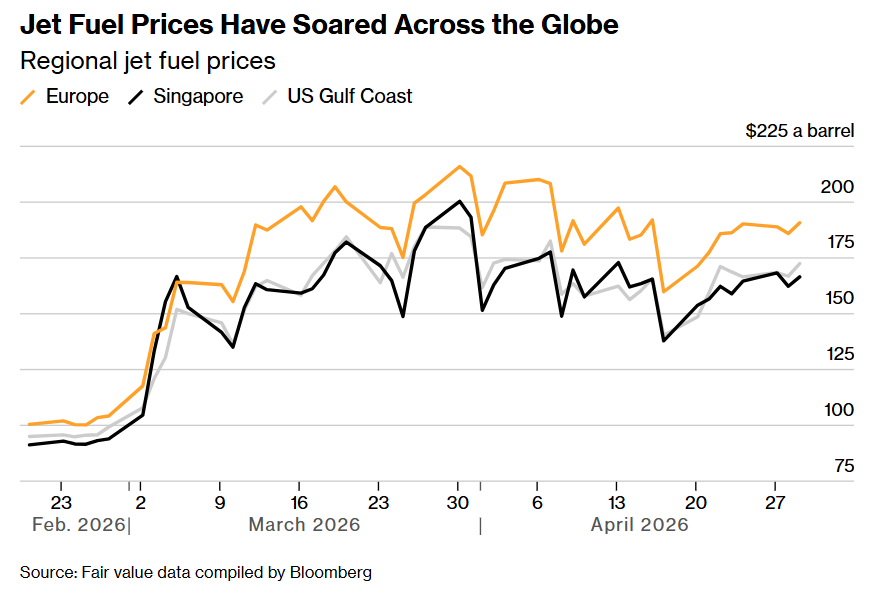

The supply response remains uneven. While Southeast Asia is adjusting through increased biofuel blending and substitution, Europe continues to rely heavily on long-haul imports to compensate for the loss of Gulf barrels.
This is translating into longer tonne-mile demand, particularly on transatlantic and West of Suez routes, which in turn supports tanker utilisation despite softer underlying cargo volumes.
Looking at Northeast Asia, Chinese authorities regulate outbound fuel volumes through a quota system that is closely aligned with domestic inventory conditions. Export approvals are only granted once internal demand is deemed sufficiently stable, a threshold that is continuously monitored by both state refiners and government bodies.
By late April 2026, this threshold appears to have been met. China Petroleum & Chemical Corporation (Sinopec) and China National Petroleum Corporation (CNPC), the country’s two key state-owned refiners, subsequently applied for export permits. Shortly thereafter, Reuters reported that Beijing had approved a one-off quota of 500,000 metric tons of refined fuel exports for May 2026, targeting Asian markets outside of Hong Kong.

Source: Discovery Alert.com.au (Beijing had approved a one-off quota of 500,000 metric tons of refined fuel exports for May 2026, directed at Asian markets outside Hong Kong.)
In Indonesia, the shortage of diesel has prompted Southeast Asia’s largest economy to fast-track the roll-out of a blend comprised 50% of biofuels from its vast oil palm plantations. That push has come as the surge in international crude oil prices lifted the cost of regular diesel far above its crop-based counterpart, a reversal of the usual pattern, traders said.

In Northeast Asia, fundamentals remain comparatively stable. Despite reduced refinery run rates in Japan and South Korea, there has been limited evidence of outright shortages, supported by strategic stockpile releases and controlled export flows.

At the same time, growing divergence within OPEC+ is adding another layer of complexity to the market. The UAE has increasingly signalled its intention to expand production capacity and maximise output, highlighting a widening gap between members focused on price stability and those prioritising market share.
While the alliance remains intact for now, this shift in positioning raises questions over long-term cohesion and the effectiveness of coordinated supply management. In the current environment of restricted Hormuz flows, any additional barrels from the region may not immediately translate into accessible supply, reinforcing the disconnect between headline production and actual deliverable volumes. This further supports the view that freight markets are being driven less by nominal supply and more by logistical constraints, routing inefficiencies, and vessel positioning dynamics.
- MR MARKET OUTLOOK FOR THE NEXT 5-7 DAYS
The MR market in East of Suez is showing early signs of consolidation following the sharp, disruption-driven rally seen through March and early April. Freight levels across key intra-Asia routes have softened modestly over the past week.
| WORLD SCALE | 27-Apr-26 | 28-Apr-26 | 29-Apr-26 | 7-DAYS AVERAGE | 1-DAY CHANGE | 7-DAYS CHANGE | 7-DAYS-CHANGE |
| SPORE/JPN (30 KT) | 332.5 | 330 | 327 | 337.13 | -3 | -25.5 | -7.23% |
| SPORE/OZ (35 KT) | 379 | 377.5 | 374.5 | 382.63 | -3 | -20.5 | -5.19% |
| SK/OZ (35 KT) | 385 | 385 | 385 | 391.56 | 0 | -15 | -3.75% |
| INDIA/JPN (35 KT) | 315 | 350 | 350 | 322.50 | 0 | 40 | 12.90% |
| $1 = $1K | 27-Apr-26 | 28-Apr-26 | 29-Apr-26 | ||||
| SPORE/HK | 785 | 755 | 745 | 785.63 | -10 | -85 | -10.24% |
| SK/SPORE | 975 | 970 | 940 | 981.88 | -30 | -50 | -5.05% |
| SK/JPN | 685 | 685 | 660 | 690.63 | -25 | -35 | -5.04% |
| SK/H.K. | 790 | 790 | 790 | 800.00 | 0 | -15 | -1.86% |
| SK/USWC | 2580 | 2580 | 2525 | 2,558.13 | -55 | 25 | 1.00% |
| WORLD SCALE | 27-Apr-26 | 28-Apr-26 | 29-Apr-26 | ||||
| AG/JPN (55 KT) | 400 | 395 | 370 | 396.25 | -25 | -30 | -7.50% |
| AG/JPN (75 KT) | 385 | 380 | 355 | 381.25 | -25 | -30 | -7.79% |
Core routes such as Spore–Japan, Spore–Oz, and Korea–Oz have retreated from recent highs after a sustained upward trend since February. While the correction appears consistent across most routes, the overall level remains elevated compared to pre-escalation benchmarks, indicating that the market is stabilising rather than reversing. The India–Japan route, however, continues to show relative resilience.
Similarly, the Platts $/day earnings reflects a mild pullback in returns across short-haul routes, particularly for Korea–Spore and Spore–Hong Kong runs. This softening is largely in line with the slight decline in Worldscale rates and points to a temporary recalibration in sentiment rather than a fundamental weakening. Notably, long-haul trades such as Korea–USWC continue to hold firm, supported by sustained tonne-mile demand and limited alternative supply routes, reinforcing the divergence between short-haul softness and long-haul strength.


As reflected in the AG–Japan LR1 and LR2 chart, rates experienced a pronounced spike during the initial escalation phase, followed by a period of correction and subsequent stabilisation. Both LR1 and LR2 segments have broadly tracked this pattern, with LR2s maintaining a slight premium, consistent with their larger parcel advantage and stronger positioning on long-haul trades. The recent flattening of the curve suggests that while sentiment remains firm, the market is no longer being driven by urgent replacement demand to the same extent as before.

Despite this consolidation, underlying support remains intact. Some Owners might try to retain flexibility to capture opportunities across nearby regions such as Oman, the Red Sea, or the West Coast of India, while also staying ready to respond quickly in the event of any reopening of Gulf flows.
However, the current phase of consolidation should be interpreted with caution, as underlying pricing signals have become increasingly distorted. The recent lawsuit filed by Mercuria against the Baltic Exchange highlights how benchmark freight indices, particularly TD3C, have struggled to reflect actual market conditions amid the effective closure of the Strait of Hormuz.
This disconnect underscores a broader point: while charts and indices suggest consolidation, parts of the market remain theoretical rather than transactional.
- REPORTED FIXTURES
| VESSEL | SIZE | GRADE | L/C | LOAD | DISCHARGE | FREIGHT | CHTRS |
| ORCHID EXPRESS | 35 | CPP | 7-May | KOREA | PHILIPPINES | 880K | ATS |
| ST. MARY | 35 | SAF | 8-May | SPORE | ARA | 2.92M | NESTE |
| LIAN HUAN HU | 35 | ULSD | 9-May | SPORE | OZ | WS375 | BP |
| HELLAS APHRODITE | 35 | CPP | 11-May | SPORE | MERAK-JAKARTA | 675K | BP |
| YASA ATLANTIC | 35 | SAF+HVO | 15-May | ZHANGJIAGANG+TJ LANGSAT | ARA | 3.95M (2:1) | ECOCERES |
| BOLAN | 55 | NAP | 10-May | STS OMAN | JAPAN | WS280 | ADMIC |

1 Comment
The invisible hands will eventually fix the market like in every crisis.