


- OVERVIEW
How Inflation Shaping the Freight Market?
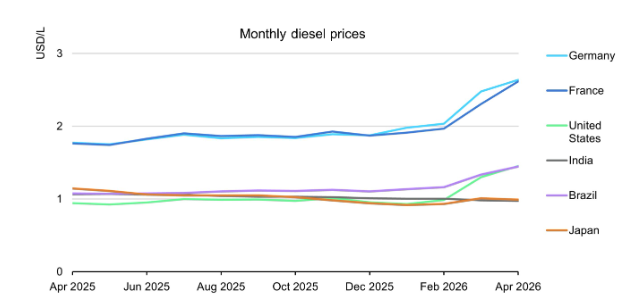
The chart shows diesel prices remaining relatively stable across most economies through 2025 before accelerating sharply into Q2 2026, particularly in Europe and parts of the OECD. Japan and India recorded fewer steep increases amid government interventions to combat tighter refining margins, elevated logistics costs, and ongoing geopolitical disruptions surrounding Middle Eastern transit routes. Higher fuel costs continue to place upward pressure on vessel operating expenses, bunker prices, and inland transportation costs, indirectly supporting freight levels as owners resist significant downward corrections in earnings.
Inflationary pressure has also extended beyond the energy complex. Rising agricultural and fertilizer costs, partly driven by geopolitical disruptions and tighter supply chains, have elevated food prices across Asia and emerging markets. Governments and refiners are increasingly balancing energy security, inflation management, and strategic stockpiling simultaneously — a combination that continues to influence refinery runs, export policies, and regional cargo movements.

A benchmark Asia rice price rose to the highest in more than a year, as worries loom over harvests across the region. Production concerns have mounted due to El Nino and fertilizer costs, the later was spurred by the war induced supply shortage.
Route diversifications are becoming increasingly visible across global oil and refined product flows. Russian crude continues to move steadily toward Asia despite sanctions, while replacement barrels from the Americas, Northwest Europe, and alternative suppliers are gradually reshaping traditional East-West energy routes. These adjustments are contributing to longer tonne-mile demand, particularly across crude, CPP, and biofuel tanker segments.
China and India remain the critical buyer of Russian’s crude. We expect WCI-Japan to stay supported and China exports to be maintained due to the supply diversification from Russia and the Americas. This trade flow is part of the adjustments to keep the global energy flowing. However the impact is contained as the buyers and carrying vessels are still very limited

Russia’s seaborne crude exports have remained resilient near multi-year highs despite sanctions, reflecting the ongoing redirection of cargoes toward Asia and alternative trading partners.

At the same time, the global energy transition continues to gather pace. Growth in renewable energy, natural gas, and alternative marine fuels is accelerating, though conventional oil and refined products remain critical to global transportation and industrial activity.
IEA Global Energy Review 2026 shows that low-emissions sources, including solar, wind, nuclear and hydropower, met nearly 60% of the growth in global energy demand last year. Solar PV recorded the largest single-year increase in electricity generation ever seen from any source – the first time on record that a modern renewable source has led global primary energy supply growth. It was followed closely by natural gas.

- MR MARKET OUTLOOK FOR THE NEXT 5-7 DAYS
While freight markets across several regional routes have softened from recent highs, persistent inflationary pressure and ongoing geopolitical uncertainty continue to provide an underlying floor to tanker earnings, particularly as owners remain reluctant to significantly discount freight amid elevated operating costs and tightening long-term supply dynamics.
| WORLD SCALE | 19-May-26 | 20-May-26 | 21-May-26 | 7-DAYS AVERAGE | 1-DAY CHANGE | 7-DAYS CHANGE | 7-DAYS-CHANGE |
| SPORE/JPN (30 KT) | 285 | 282 | 279 | 295.69 | -3 | -35 | -11.15% |
| SPORE/OZ (35 KT) | 327.5 | 325 | 322.5 | 335.63 | -2.5 | -27.5 | -7.86% |
| KOREA /OZ (35 KT) | 325 | 322.5 | 320 | 338.44 | -2.5 | -40 | -11.11% |
| INDIA/JAPAN (35 KT) | 300 | 275 | 275 | 300.00 | 0 | -40 | -12.70% |
| $1 = $1K | 19-May-26 | 20-May-26 | 21-May-26 | ||||
| SPORE/HK | 645 | 640 | 635 | 667.50 | -5 | -65 | -9.29% |
| KOREA/SPORE | 700 | 700 | 700 | 744.38 | 0 | -100 | -12.50% |
| KOREA/JAPAN | 480 | 470 | 470 | 507.50 | 0 | -85 | -15.32% |
| KOREA/H.K. | 600 | 600 | 600 | 638.13 | 0 | -80 | -11.76% |
| KOREA/USWC | 2100 | 2090 | 2090 | 2,124.38 | 0 | -80 | -3.69% |
| WORLD SCALE | 19-May-26 | 20-May-26 | 21-May-26 | ||||
| AG/JAPAN (55 KT) | 318 | 305 | 300 | 323.50 | -5 | -42.5 | -12.41% |
| AG/JAPAN (75 KT) | 285 | 270 | 265 | 298.13 | -5 | -57.5 | -17.83% |


- SMALL TANKERS MARKET UPDATE
The Intra-SEA trade lane remained soft this week, largely in line with last week’s sentiment. Spot activity has been quiet across most product segments, with limited fresh movement seen. CPP continues to move, though at significantly lower volumes compared to last month, with owners mostly fixing short-haul voyages within the Straits or into Indonesia. However, this demand remains insufficient to absorb the excess prompt tonnage in the market. Vessels of various sizes are generally opening from end-May onwards, with only limited units open prompt. Freight remains under pressure, further weighed down by continued declines in bunker prices.
The Intra-FEAST market remained broadly stable this week, with cargo activity supported by higher run rates at South Korean BTX producers and the return of several Japanese plants from maintenance. COA volumes continue to move steadily, keeping cargo flow largely unchanged from previous weeks. However, freight has yet to strengthen as tonnage remains sufficient across the region, further supplemented by owners repositioning vessels into the Straits market for stronger southbound earnings. Overall, freight levels continue to hover around last-done levels despite the stable cargo environment.
Southbound demand remains relatively firm, with enquiries centered mainly on toluene, MEAC, methanol, MEG and caustic soda for 2H June loading dates. MTBE activity has eased somewhat, though overall cargo volumes remain healthy. Despite this, freight has struggled to gain momentum as the majority of stems are forward-dated, leaving prompt and early-June tonnage competing for limited employment.
- REPORTED FIXTURES
| VESSEL | SIZE | GRADE | L/C | LOAD | DISCHARGE | FREIGHT | CHTRS |
| VNR | 10 | MTBE | 10-Jun – 20-Jun | MID CHINA | SINGAPORE | $440K L/S | CNR |
| VNR | 10 | TOLUENE | 10-Jun – 20-Jun | SOUTH CHINA | SINGAPORE | $400K L/S | CNR |
| MALBEC HORIZON | 35 | GO | 29-May | JINZHOU | VIETNAM | 725K | PETROLIMEX |
| NAVIG8 GOAL | 35 | ALKY | 31-May | TAIWAN | USWC-SPORE | 2.15M-625K | P66 |
| ECOMAR GIRONDE | 35 | NRD/SAF | 03-Jun | SPORE | UK-CONT | 3.1M | NESTE |
| VELOS AMBER | 55 | NAP | 29-May | YANBU | JAPAN | W325 | ATC
|
- GLOBAL BUNKER PRICE REPORT

- MARKET WATCH
The stocks of major MR tanker players closed softer this week amid persistent inflationary pressure and broader macroeconomic uncertainty. Concerns over slowing global growth, elevated operating costs, and weaker refining margins continued to weigh on market sentiment despite relatively stable tanker fundamentals.
However, ongoing supply diversification, geopolitical disruptions, and longer-haul trade flows continue to provide underlying support to the freight market.



11 Comments
This Iran crisis provides a stronger impetus for alternative energies. Maybe this is one of the silver linings.
The higher usd shld cushion the impact of inflation
I think the tanker shipping business continues to grow as an integral part of the global supply chain, alongside the increasing world population and rapid technological advancements.
In today’s environment of uncertainty, volatility, and geopolitical challenges, tanker companies and shipbrokers are increasingly required to demonstrate high levels of creativity and adaptability. They must continuously study both external and internal factors that influence the sustainability and competitiveness of their businesses.
As a result, having skilled human capital capable of conducting thorough analysis and making strategic decisions has become essential. Excellence in operational efficiency, intelligent marketing, and cost optimization are now critical factors for maintaining a company’s long-term success and resilience.
Interesting read. Inflation is clearly influencing not just costs, but also trade flows and tanker demand.
Great article. While global macro shifts are unavoidable, the industry must proactively optimize cost efficiency and structure balanced contractual frameworks to shield both owners and charterers from sudden volatility. Implementing co-loading strategies, forward-dated COAs, and eco-speed matrices alongside retrofitting flexible tonnage to accommodate diverse liquid cargoes could be considered as solutions to counter current challenges.
An interesting read! I’m not an expert in the tanker market, but it’s clear that inflation is a huge headache for everyone right now, including ship operations. Higher fuel prices and refinery costs sound like a tough challenge to handle. Thanks for breaking down the macroeconomic impact into something easier to understand.
Thanks for this well written article. Inflation is no longer just a macroeconomic headline—it is now directly affecting voyage economics, cargo movements, and freight negotiations across the tanker market.
Very informative, good read.
Very interesting perspective. Many Owners are facing declined stock prices. Hopefully market conditions will improve, and we will see a stronger and healthier market in the near future. Thanks for sharing this insightful article.
Great read on the various factors driving today’s tanker and freight markets
Thanks for sharing. Learned something new about how inflation and fuel prices can affect the tanker market.